
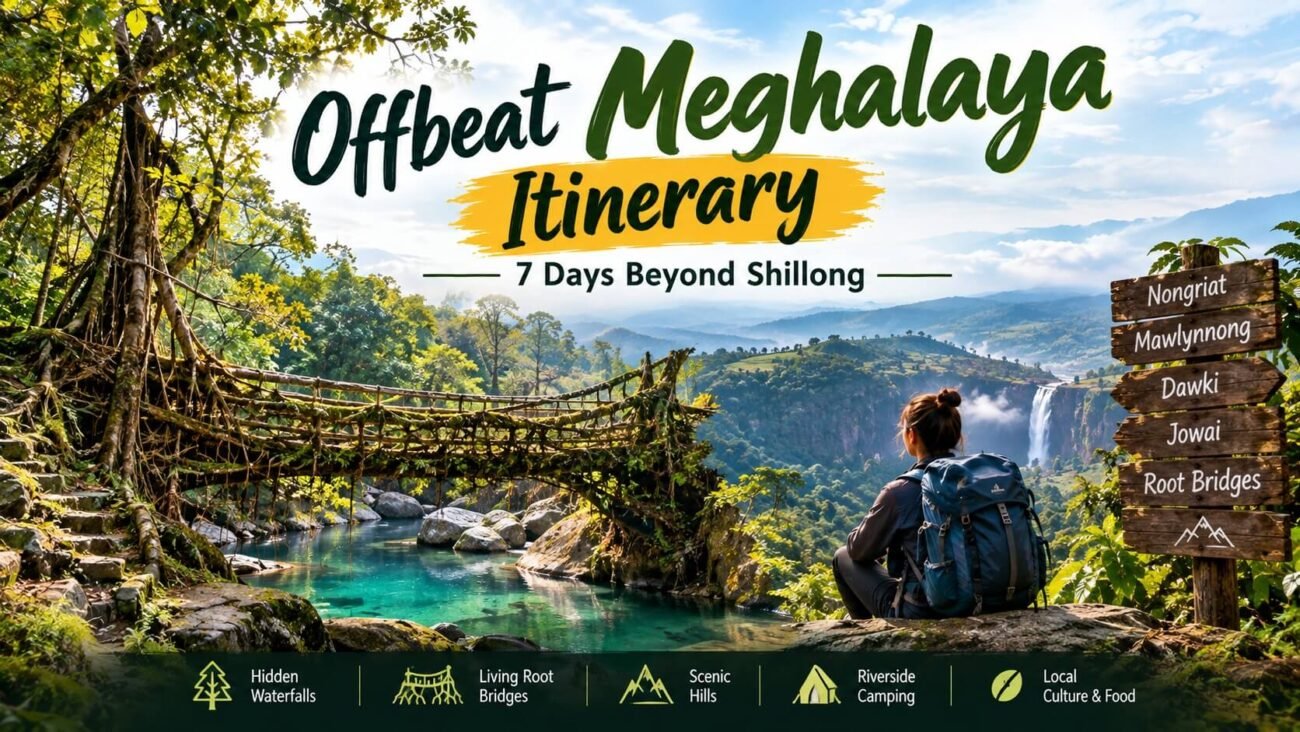
Most visitors treat Meghalaya like a checklist. They land in Guwahati, drive to Shillong, tick off Cherrapunji, and fly home.
That route is pretty. It is also crowded, and it skips the quietest corners of the state.
This offbeat Meghalaya itinerary takes a different path. It starts near Guwahati, loops through sacred forests and living root bridges, and ends in the Jaintia Hills.
You will sleep in homestays, riverside tents, and village guesthouses. You will walk more than you expect. You will also eat better than you expect.
Pack sturdy shoes, a rain jacket, and plenty of cash. Everything else falls into place.
Why Choose an Offbeat Route in Meghalaya
Shillong and Cherrapunji deserve their fame. They also absorb most of the state’s tourist traffic. Weekend queues at the famous waterfalls prove it.
A smart offbeat Meghalaya itinerary spreads your time across three regions. The Khasi Hills give you forests and root bridges. The border belt gives you glass-clear rivers. The Jaintia Hills give you monoliths and quiet waterfalls.
This plan also suits a Meghalaya backpacker trip. Homestays cost little, shared taxis run daily, and villagers welcome walkers.
We built this offbeat Meghalaya itinerary as one loop, so you never backtrack. Each day moves you forward. You spend more time exploring and less time sitting in a car.
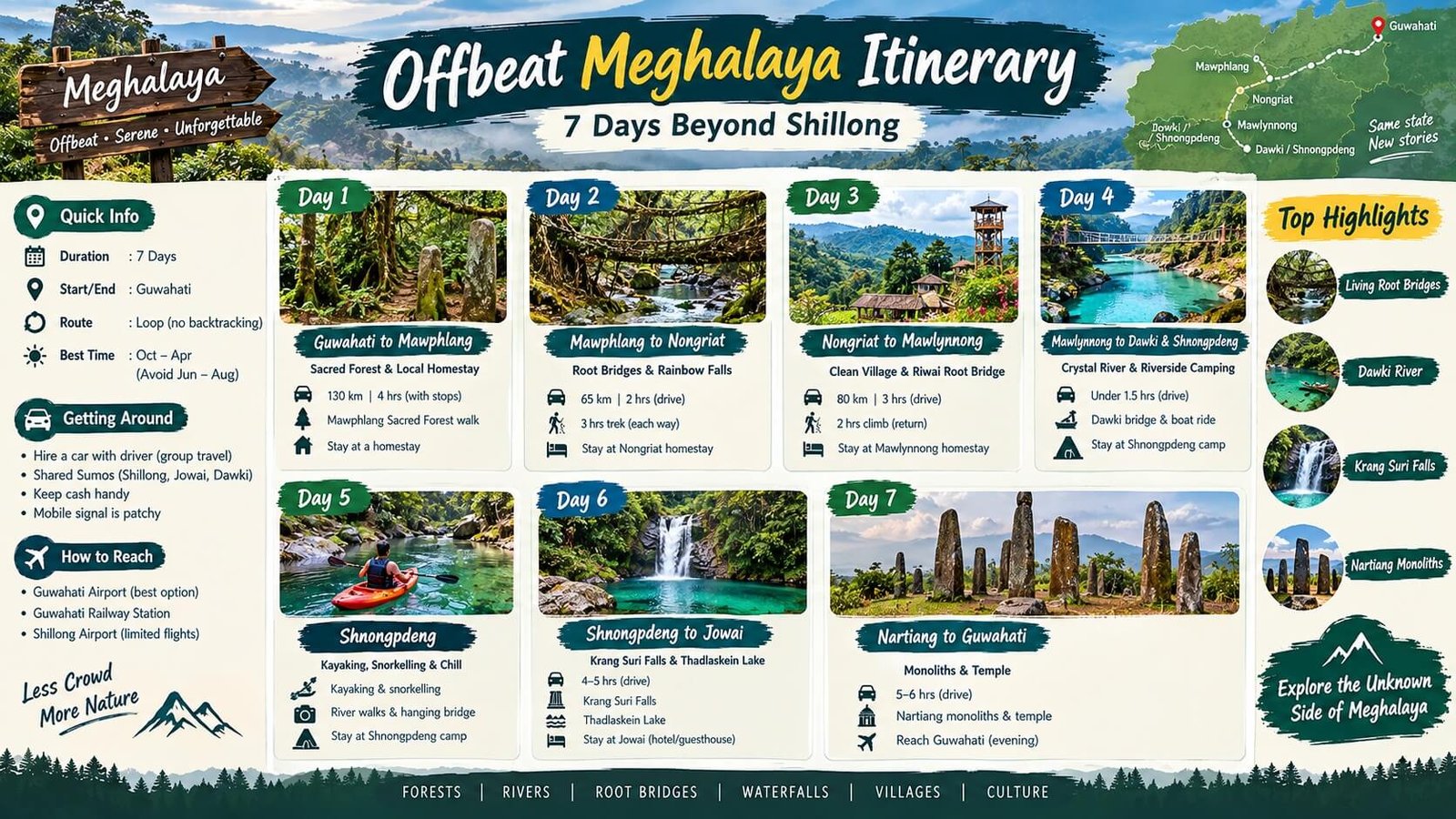
The 7-Day Route at a Glance
Here is the full offbeat Meghalaya itinerary before we dive into the details.
| Day | Night Stay | Main Highlight | Travel Effort |
|---|---|---|---|
| 1 | Mawphlang | Sacred Forest walk | About 4 hours by road |
| 2 | Nongriat | Double Decker Root Bridge, Rainbow Falls | 2 hours by road, 3 hours trekking |
| 3 | Mawlynnong | Clean village, Riwai root bridge | 2 hours climbing, 3 hours by road |
| 4 | Shnongpdeng | Dawki bridge, riverside tents | Under 1.5 hours by road |
| 5 | Shnongpdeng | Kayaking, snorkelling, river walks | Minimal |
| 6 | Jowai | Krang Suri Falls, Thadlaskein Lake | 4 to 5 hours by road |
| 7 | Guwahati | Nartiang monoliths | 5 to 6 hours by road |
Drive times assume dry roads and steady traffic. Mountain roads slow everyone down. Add an hour to each estimate when rain arrives.
Best Time to Follow This Route
Plan your offbeat Meghalaya itinerary between late October and April. The monsoon retreats by October, trails dry out, and waterfalls still run strong.
November to March gives the clearest river water near Dawki. Winter mornings turn cold in the hills, so carry a warm layer.
Avoid June to August. Landslides block roads, and the Nongriat steps become slick and risky.
Getting to Meghalaya and Moving Around
Guwahati is your gateway. Its airport and railway station connect to most Indian cities. Shillong’s airport has limited flights, so Guwahati remains the safer bet.
Hire a car with a driver if you travel in a group. Four people split the cost easily. Solo travellers can use shared Sumos between hubs like Shillong, Jowai, and Dawki.
Keep your offbeat Meghalaya itinerary flexible, because shared jeeps leave only when full. Start early, ask around, and stay patient. A Meghalaya backpacker trip rewards patience more than planning.
Carry cash for the entire trip. ATMs vanish beyond the main towns. Mobile signal also drops in Nongriat and parts of the border belt.
Day 1: Guwahati to Mawphlang
Collect your cab at Guwahati airport or the railway station. Leave by 8 am. The drive covers roughly 130 km and takes about four hours with stops.
The highway climbs to Umiam, where a tea stop beside the lake feels earned. Skip Shillong’s city centre. Your driver can use the bypass road toward Mawphlang.
Mawphlang Sacred Forest is the star of the day. Khasi communities have protected this grove for generations. Locals believe a forest guardian watches over every tree.
Nobody removes even a dead leaf from here. Take that rule seriously. Local belief says misfortune follows anyone who breaks it.
Hire a local guide at the entrance. They explain the moss-covered trunks, the old stone monoliths, and the rituals tied to the grove. The walk takes about an hour.
Check into a homestay in or near Mawphlang. Evenings feel still. Mist rolls over the open grassland, and dinner usually features rice, local greens, and a simple meat curry.
Your first night sets the tone for this offbeat Meghalaya itinerary. Slow down, listen, and sleep early.
Day 2: Mawphlang to Nongriat
Leave early and drive about 65 km to Tyrna, the trailhead village near Cherrapunji. Expect roughly two hours on the road.
You skip the busy tourist stops in Cherrapunji town. The trek is your reward.
From Tyrna, around 3,000 steps drop through dense forest toward Nongriat. Your knees feel the descent, and your thighs feel the climb back.
Walk slowly and stop often. Single-span bridges appear first. Then the village opens up, and the real star arrives.
The Nongriat root bridges are not built. They are grown. Khasi people guide the roots of the rubber fig tree across rivers using bamboo and areca trunks. A bridge needs 15 to 30 years before it carries weight.
The Umshiang Double Decker Root Bridge stacks two living spans above a clear stream. Some of these bridges have survived for well over a century. Families still maintain them.
Rainbow Falls lies beyond the village. The walk takes about an hour each way and crosses iron suspension bridges. In the right light, a rainbow forms above the green pool.
No offbeat Meghalaya itinerary feels complete without these bridges. Stay at a Nongriat homestay. Rooms are basic, and meals follow a set time. Nobody takes cards here, so carry cash.
Evenings sound like running water and crickets. You will not miss your phone.
Day 3: Nongriat to Mawlynnong
Start climbing by 7 am. The ascent to Tyrna takes around two hours. Carry water and snacks, and rest whenever your legs ask.
Your driver should wait at Tyrna. The drive to Mawlynnong covers roughly 80 km and takes about three hours.
Mawlynnong earned fame in 2003 when a travel magazine called it Asia’s cleanest village. The title stuck. Bamboo dustbins line the lanes, and residents sweep daily.
Walk the village slowly. Flower gardens sit beside neat wooden houses. Children wave from porches. The air smells of wet leaves and woodsmoke.
Visit the nearby village of Riwai next. Its living root bridge is easier to reach than the Nongriat ones. The walk is short, and the roots wrap thickly across the stream.
Climb the bamboo Sky View tower before sunset. On clear evenings, you can see the plains of Bangladesh stretching far below the hills.
Book a homestay in Mawlynnong in advance. Rooms fill during weekends, even outside peak months. A good offbeat Meghalaya itinerary still needs a few confirmed beds.
Day 4: Mawlynnong to Dawki and Shnongpdeng
Leave after breakfast. The drive to Dawki takes under an hour. Shnongpdeng lies a short drive beyond.
Carry a photo ID today. Dawki sits on the international border, and checkpoints are common.
Stop first at the Dawki suspension bridge. The British built it in 1932 across the Umngot River. The bridge still carries pedestrians and light traffic.
Below it, the river runs so clear that boats seem to float on air. Sunlight reaches the pebbles on the bed. Locals often rank the Umngot among the cleanest rivers in India.
Boat rides at Dawki are popular, so expect crowds on weekends. Go early. Mornings stay quiet and bright.
The middle of this offbeat Meghalaya itinerary turns to water. Shnongpdeng camping is the highlight of the day. Tents and bamboo huts sit right beside the river. Most camps offer bonfires, simple meals, and river access.
Pitch yourself in a tent facing the water. Dip your feet in before dinner. The river stays cool even in warm weather.
Wear life jackets whenever you swim or paddle. Water levels change quickly after rain upstream. Follow your camp host’s advice without argument.
Day 5: A Full Day at Shnongpdeng
Today is your reset day. No luggage, no road, no hurry.
Book kayaking in the morning. Paddlers glide above rocks that look close enough to touch. Local operators lead the sessions and hand out lifejackets.
Try snorkelling next. Fish, stones, and green plants appear below you with remarkable clarity. Ask your host which stretch is safest that day.
After lunch, walk across the hanging bridge in Shnongpdeng. The views upstream are worth the shaky steps. Then follow the riverbank path toward quieter pools.
Daring travellers can try the rock jumping spots. Check depth with your guide first. Never jump alone, and never jump after heavy rain.
Nobody regrets a slow day in an offbeat Meghalaya itinerary. Evenings bring the best part of Shnongpdeng camping. Bonfire smoke curls upward, guitars come out, and strangers become friends. The stars here look closer than anywhere else on this route.
Winter calms the current and lets silt settle. That is why the river looks clearest between November and March.
Day 6: Shnongpdeng to Jowai via Krang Suri Falls
Wake early and drive toward Amlarem. The road winds through pine forests and small Jaintia villages. Plan four to five hours with stops.
Krang Suri Falls waits near Amlarem. A broad cascade drops into a pool of bright turquoise water. The sandy shore makes it a pleasant place to rest.
Local rules apply here, so ask before swimming. Pools can be deeper than they look.
Continue to Jowai, the Jaintia Hills headquarters. It is a working town, not a tourist spot. That is exactly why it feels honest.
Visit Thadlaskein Lake near town. Legend says Jaintia warriors shot arrows into the ground, and water rose in every hole. The calm lake now hosts evening walkers and quiet picnics.
Eat dinner at a local eatery. Try jadoh, a Khasi rice dish cooked with meat. Add a side of tungrymbai, a fermented soybean dish with a smoky taste. Both are widely eaten across the region.
An offbeat Meghalaya itinerary gets richer when you eat where locals eat.
Day 7: Nartiang to Guwahati
Spend your last morning at Nartiang, about 15 km from Jowai. It hosts one of the largest collections of monoliths in the region.
Jaintia chiefs raised these stone pillars as memorials. The tallest ones rise several metres above the grass. Walk among them slowly. They feel older than any signboard suggests.
A centuries-old temple stands nearby. The Nartiang Durga Temple is a revered shrine in local tradition. Visit with respect and dress modestly.
The last stop of the offbeat Meghalaya itinerary ends among stones. Begin the drive to Guwahati by noon. The trip takes five to six hours. Book flights or trains for late evening to leave a safe buffer.
A Rough Budget for a Meghalaya Backpacker Trip
These are approximate numbers per person per day. Prices change with season, so confirm with each host.
| Expense | Approximate Cost per Day |
|---|---|
| Homestay or dorm bed | Rs 600 to Rs 1,500 |
| Riverside tent at Shnongpdeng | Rs 1,000 to Rs 2,500 |
| Meals | Rs 300 to Rs 600 |
| Shared transport | Rs 200 to Rs 800 |
| Entry fees, guides, activities | Rs 100 to Rs 600 |
Most travellers spend between Rs 1,800 and Rs 3,500 per day on this offbeat Meghalaya itinerary. Group cab hire changes the math, so split it evenly. Camps and homestays usually include dinner, which lowers your food spend.
Keep a small cash reserve for emergencies. This offbeat Meghalaya itinerary passes many places without ATMs.
Read More: Weekend in Chikmagalur: The Best Route, Stops, and Coffee Estates from Bangalore
What to Pack
Your bag decides your comfort here. Pack for the offbeat Meghalaya itinerary with rain in mind, and keep the load light.
| Item | Why You Need It |
|---|---|
| Grip shoes | Nongriat steps stay wet and slippery |
| Quick-dry clothes | Cotton stays damp for days |
| Rain jacket | Showers appear without warning |
| Power bank | Electricity is patchy in remote homestays |
| Torch or headlamp | Village lanes go dark early |
| Reusable water bottle | Plastic waste harms fragile villages |
| Small first aid kit | Pharmacies are far from the trails |
Five Things Most Meghalaya Guides Skip
These details make your offbeat Meghalaya itinerary smoother. Most listicles never mention them.
- First, Meghalaya’s sun sets early. In winter, darkness arrives around 4:30 pm. Plan your drives to finish before dusk.
- Second, Sundays change the rhythm. Many Christian villages observe the day quietly. Shops may close, so stock up on snacks on Saturday.
- Third, Khasi society follows a matrilineal system. The youngest daughter, called the khatduh, inherits ancestral property. You will notice women running most homestays and shops.
- Fourth, living root bridges are not attractions in the usual sense. Families maintain them as everyday infrastructure. Stay on the path, and never pull the roots.
- Fifth, a smile and a greeting go far. Say khublei to say hello or thank you. Locals notice the effort.
Travelling Responsibly
Remote villages face pressure when visitors arrive in large groups. Responsible habits keep any offbeat Meghalaya itinerary sustainable.
Carry all your trash out. Stay in homestays that employ local people. Hire local guides at forests and bridges. Ask before you photograph residents.
Respect sacred spaces. Do not take stones, leaves, or flowers from the groves. Keep voices low near shrines and monoliths.
Treat the water well. Avoid soap or shampoo in rivers at Dawki and Shnongpdeng. Clear water stays clear only when visitors care.
Safety Notes for Remote Stretches
Safety planning matters more than gear here. Treat these notes as part of your offbeat Meghalaya itinerary, not an afterthought.
Download offline maps before you leave Guwahati. Share your route with someone at home. Tell homestay hosts when you plan to leave for long treks.
Start trekking early so you finish by afternoon. Forest trails lose light fast. Avoid the Nongriat steps after heavy rain.
Drink boiled or filtered water. Carry basic medicines for stomach trouble, cuts, and blisters.
Customising the Route
You can trim or stretch this plan easily. Add a day at Nongriat if you love trekking. Add a night at Shnongpdeng if you love water.
Short on time? Combine Days 4 and 5 into one night. You will lose the slow river day but keep the core of the offbeat Meghalaya itinerary.
Travelling in a group of four or more? Hire one cab for the entire trip. It saves effort and gives you stops at will.
Want even less crowd? Visit on weekdays. Villages feel quieter, and homestay hosts have more time to chat.
Prefer a longer stay? Stretch this offbeat Meghalaya itinerary to ten days by adding Mawsynram and the Garo Hills. Both reward patient travellers.
Final Thoughts
Meghalaya rewards the people who slow down. This offbeat Meghalaya itinerary trades checklists for conversations, steps, and stars.
You will cross living bridges older than your family tree. You will swim in rivers clearer than any pool. You will sleep in villages where clocks run softer.
Follow this offbeat Meghalaya itinerary once, and the usual circuit will feel too small. Pick your dates, book your first homestay, and start walking.
Frequently Asked Questions
1. How many days do you need for an offbeat Meghalaya itinerary?
Seven days cover the full loop comfortably. You can compress it to five by skipping the Jaintia Hills. Ten days let you add the Garo Hills and slow down at every stop.
2. Is Shnongpdeng camping safe for solo travellers and women?
Yes, most camps are run by local families and feel safe. Choose a camp with good reviews and clear tent locks. Ask hosts about river conditions, and avoid swimming alone after dark.
3. How hard is the trek to the Nongriat root bridges?
The trek is moderate and relies on stone steps. The descent is easy, but the climb back tests your stamina. Wear grip shoes, start early, and rest often. Most fit beginners finish without trouble.
4. What does a Meghalaya backpacker trip cost per person?
Expect Rs 1,800 to Rs 3,500 per day, depending on tents, cabs, and activities. Homestays and shared transport keep costs low. Check current prices before you travel, because rates vary by season.
